The Lincoln Journal-Star had a front page article about Sandhill cranes this morning.
NEAR GIBBON - Doing the crane thing required a serious commitment from Jim and Edna Huggett.
The Marshall, Wis., retirees drove nearly 600 miles, woke a couple of hours before sunrise and endured a chilling walk to arrive at a blind along the Platte River in central Nebraska.
At first, they and 26 other crane tourists could just barely make out gray avian shapes in the twilight. But as darkness retreated, a gauzy light revealed clusters of sandhill cranes up, down and across the wide, shallow channel of the Platte.
They numbered in the thousands.
A chorus of calls grew in volume with the gathering dawn. Then, without warning, a clutch of cranes upstream from the blind lifted off, peeling downstream birds with them like gift wrap. The chorus turned into a roar not dissimilar to the sound that follows a touchdown at perpetually sold-out Memorial Stadium.
Much more, plus some photos at the link above.
For more information about Sandhill crane viewing, see my post from earlier in the year.
An article in the online hometown newspaper about Sandhill crane viewing reminded me that it was time to do a post about crane viewing in Central Nebraska in March. I've pulled up last years post, checked all the links, deleted a couple that no longer work, deleted some things, added some things, and, in general, done some editing.
Rowe Sanctuary is operated by Audubon. Their center is located on the Platte River and is beautifully situated. They have blinds where the cranes can be observed. Check their site for information about blinds. If for no other reason, they deserve a visit because their building is the second largest straw bale building in the United States. They also provide other information regarding crane viewing. They also have a really nice gift shop. In the interests of full disclosure, I am a dues paying member in Audubon, but otherwise unaffiliated with Rowe Sanctuary.
In past years Rowe Sanctuary had a Cranecam. I don't see any information about that on their site for this year. When and if that information becomes available, I will update this post.
The Nebraska Game and Parks Commission also has some general information about crane viewing. There’s also a section on crane viewing etiquette.
The three main places to hang out during your stay are Grand Island, Hastings, and Kearney. The visitor’s bureau for Grand Island The visitor’s bureau for Hastings The visitor’s bureau for Kearney (has a crane video)
My personal preference is to stay in Kearney, but there are good reasons to stay in Grand Island or Hastings.
For a birding enthusiast there’s much more going on. Seven to ten million Snow geese, Canada geese, and ducks pass through the area. Other migrating birds are starting or are in the middle of their migration.
Nebraska Birding Trails has oodles of information of birding throughout the state. If you doubt that there are places to bird in the area, these two maps will dispel that notion. Maps are here and here. (pdf)
The Nebraska Flyway site was new last year, and when I pulled it up a little bit ago, I spent a fair bit of time there. I think it is probably the most comprehensive site of all the sites highlighted in this post. If you click on only one link, that's the one.
Nebraskaflyway.com has printable maps of the Platte River viewing sites, of a tour of the Western tour of the Rainwater Basin and of the Eastern tour of the Rainwater Basin. (all maps pdf) More information about the Rainwater Basin. Last year I followed the prescribed routes on both maps and I thought it was a very organized way to tour the area. As you go from county to county, roads names change, and these maps cover the road names very well. Conditions in these areas vary from year to year based on the amount of rain or snow we have had. Many of the roads are county roads (read gravel) and their conditions will also vary according to weather conditions.
Both Rowe Sancturary and Nebraska Nature & Visitor Center (formerly known as Crane Meadows) have blinds where you can watch the cranes come in at night, and leave in the morning. If you have never experienced one or the other, I heartily recommend doing both at least once. It is a sensory experience that, in my opinion, is unparalled.
Also, Fort Kearney State Receation Area has the Fort Kearney State Recreation Trail. There is a bridge over the Platte River that is excellent for watching the cranes come to their nighttime roost. It’s also an excellent place for sunset pictures over the Platte River. A daytime stroll on this path will usually offer the opportunity to see songbirds.
It can be wickedly cold in Nebraska at this time of year. Don’t forget your longjohns and bring clothes you can layer. Weather can be unpredictable. Sunshine and in the 50’s one day, snow the next day, and everywhere and anywhere in between.
For your viewing pleasure: A You Tube Video of Sandhill cranes near Fort Kearney State Recreation Area and of thousands of geese on lake behind Grandpa's Steakhouse located south of I-80 in Kearney. The video is from March 4, 2009.
Just to add a little spice to the viewing....The past couple of years a Common Crane has been spotted. The Common Crane is not considered to be a North American bird. It breeds in wetlands of northern parts of Europe and Asia.
I hope you find these resources helpful. If there is something else that you feel could or should be covered, feel free to leave a comment. I’ll keep an eye on the comments section and respond.
Last but not least, thanks for stopping by my corner of the world. If you come to see the awesome wonder of the crane migration, enjoy, enjoy, enjoy.
I spent last Thursday and Friday at Squaw Creek NWR. The weather was pleasant and there were a fair amount of birds to be seen.
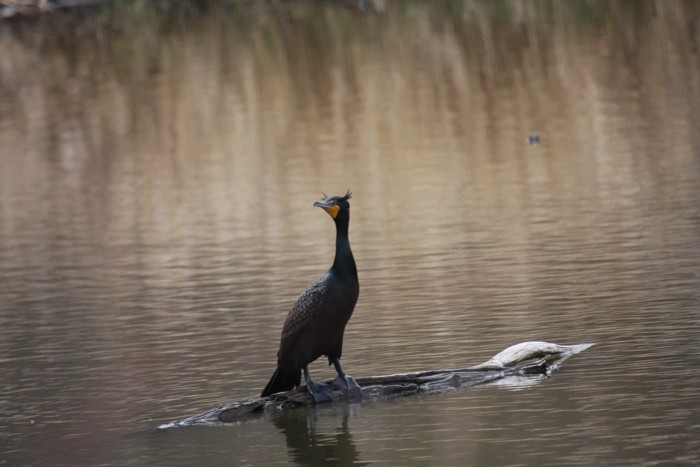
Have you ever wondered why Double-crested cormorants are called double-crested? During the breeding season they have crests. The crests are very evident in this photo. Kind of neat, huh?
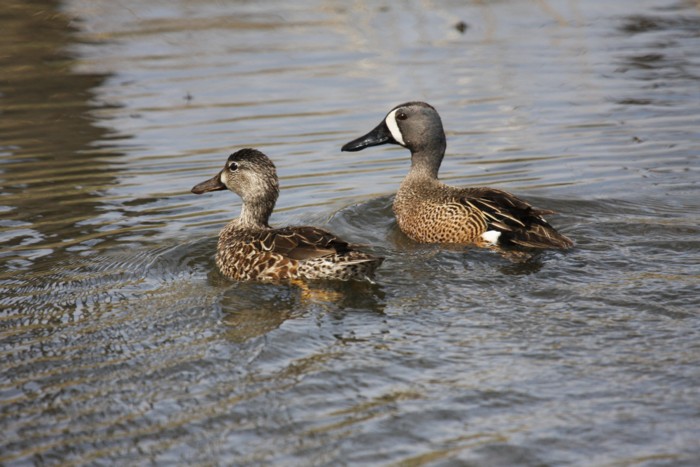
There were lots of Blue-winged teals
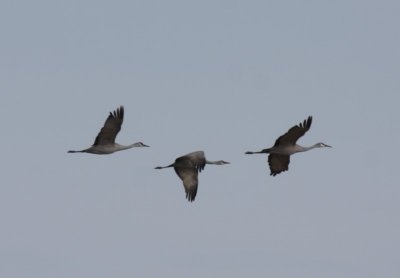
And then I had quite a surprise. My first thought was that is sure a strange looking heron. Must be the light. Then I looked through the binoculars and realized the “heron” was in fact a Sandhill crane. Now one does not go to Squaw Creek in late April and expect to see a sandhill crane, but there he/she was.
I cropped the crane so it can be seen clearly. The original photo is here.
Last night there was a post on the Nebraska Hotline that a Common Crane had been seen in Nebraska again this year. The Common Crane is not considered to be a North American bird. It breeds in wetlands of northern parts of Europe and Asia.
Photos of this years Common Crane can be seen here
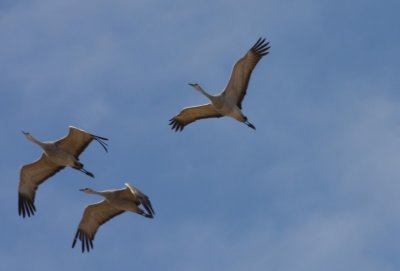
Every year, during March and early April, more than 80% to 90% of the world's population of Sandhill cranes pass through the Platte River Valley. It is the largest assembly of sandhill cranes in the world. The cranes come to rest and refuel as they prepare to journey to breeding grounds in Canada, Alaska, and Siberia.
The cranes using the Platte River is not a new phenomenon. Fossil remains of a sandhill crane date as far back as 8 million years.
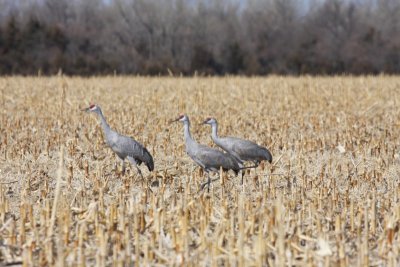
During the day the sandhill cranes feed on waste corn in corn fields adjacent to the Platte River. The corn is about 90% of their diet. The remainder of their diet consists of insects, earthworms, snails and plants. During their stop in Nebraska, cranes will gain nearly 10% of their body weight.
The cranes spend the night on sandbars in the Platte River. The river offers the cranes protection from predators during the night. Being in a blind along the Platte River to watch the cranes come back to the Platte at night, or to watch them lift off in the morning is an awesome experience. I did neither this year. But watching them feeding in the corn fields is interesting also.
One of the posters on the Nebraska Birding Hotline posted a link to this You Tube Video of Sandhill cranes near Fort Kearney State Recreation Area and thousands of geese on lake behind Grandpa's Steakhouse located south of I-80 in Kearney. The video is from March 4.
For more Sandhill Crane resources click here and here.
Thought I would put together a quick and dirty post on Sandhill Crane resources. To me, this is the time of year a Nebraska birder looks forward to the most, but I’ll leave the adjectives to the cited resources!
Rowe Sanctuary is operated by Audubon. Their center is located on the Platte River and is beautifully situated. They have blinds where the cranes can be observed. If for no other reason, they deserve a visit because their building is the second largest straw bale building in the United States. Lots of other interesting information at their site. The birding list for Rowe (pdf) is representative of birds in the area. CraneCam will be active from March 7 until April 8.
A new site this year that I really like, is Nebraskaflyway.com. More on that site later.
The Nebraska Game and Parks Commission also has some general information about crane viewing. There’s also a section on crane viewing etiquette.
The three main places to hang out during your stay are Grand Island, Hastings, and Kearney. The visitor’s bureau for Grand Island The visitor’s bureau for Hastings The visitor’s bureau for Kearney
My personal preference is to stay in Kearney, but there are good reasons to stay in Grand Island or Hastings.
For a birding enthusiast there’s much more going on. Seven to ten million Snow geese, Canada geese, and ducks pass through the area. Other migrating birds are starting or are in the middle of their migration. As of the writing of this post, Snow geese are abundant.
Nebraska Birding Trails has oodles of information of birding throughout the state. If you doubt that there are places to bird in the area, these two maps will dispel that notion. Maps are here and here. (pdf)
Nebraskaflyway.com has printable maps of the Platte River viewing sites, of a tour of the Western tour of the Rainwater Basin and of the Eastern tour of the Rainwater Basin. (all maps pdf) More information about the Rainwater Basin. About a week ago I took the eastern tour route, and it is a very organized way to tour the area. Having been to most, if not all of the areas covered in the western tour route, it appears to be an organized way to approach that area also. As you go from county to county, roads names change, and these maps cover the road names very well. Conditions in these areas vary from year to year based on the amount of rain or snow we have had. Many of the roads are county roads (read gravel) and their conditions will also vary according to weather conditions.
Birding Adventures of Southwest & Central Nebraska has some tours of the area in their left sidebar. The fun part of their tours is they talk about the local flavor of rural Nebraska. They also suggest restaurants along the way. (no chain restaurants included!) Their tours are also printable with maps.
The last link I will provide is for Fort Kearney State Recreation Trail. There is a bridge over the Platte River that is excellent for watching the cranes come to their nighttime roost. It’s also an excellent place for sunset pictures over the Platte River. A daytime stroll on this path will usually offer the opportunity to see songbirds.
It can be wickedly cold in Nebraska at this time of year. Don’t forget your longjohns and bring clothes you can layer. Weather can be unpredictable. Sunshine and in the 50’s one day, snow the next day, and everywhere and anywhere in between.
I hope you find these resources helpful. If there is something else that you feel could or should be covered, feel free to leave a comment. I’ll keep an eye on the comments section and respond. And if you find the resources helpful, a shout out would be nice too. Okay, now I’m starting to beg…..
Last but not least, thanks for stopping by my corner of the world. If you come to see the awesome wonder of the crane migration, enjoy, enjoy, enjoy.






 Posts
Posts


