Showing posts with label Nebraska History. Show all posts

Monday, April 27, 2009

That's My World--Naval Ammunition Depot

A couple of months ago the AAA magazine had a short article about how Hastings, a small town (population about 25,000) west of Lincoln had created Greenscape Park. It was created where a building in downtown had burned down. There were supposed to be thousands of tulips, shrubs and trees. When I read the article, I thought perhaps it would make an interesting "That’s My World!" post. I went last week because the tulips were blooming in Lincoln, so I figured they would be blooming there also. One would think that a place large enough to incorporate thousands of tulips would be fairly easy to find. Well, so much for what one thinks. I never found it. Miz Winnie (picture in sidebar) accompanied me, and for some reason she was unusually restless. Perhaps she sensed my mounting frustration at not finding the Park.

Fortunately, I had a second destination for the day. It was the Naval Ammunition Depot.
Hastings was buzzing with excitement on June 10, 1942, six months after Pearl Harbor, when Senator George Norris and Congressman Carl Curtis announced that the Navy had authorized the establishment of a $45,000,000 Naval Ammunition Depot southeast of Hastings. The Hastings area was chosen because of its abundance of electrical power from the Tri-County project, its location equidistant from both coasts and the availability of railroads. The government immediately began the process of taking 48,753 acres of farmland, located mostly in Clay County, from 232 owners.


From the Adams County Convention and Visitors Bureau
The Naval Ammunition Depot known locally as "The NAD," was the largest of four munitions depots in the country and was known for supplying 40 percent of the Navy's ammunition supply at one point during WWII.


The facility produced bombs, rockets, torpedoes, mines, bagged powder and all calibers of smaller ammunition.

There were three other NAD plants located in Burns City, Indiana; McAlester, Oklahoma and Hawthorne, Nevada.

After the NAD served it’s military usefulness
…in December 1958 disestablishment was ordered, to be completed no later than June 30, 1966.
In September 1964, 10,236 acres near Clay Center were transferred to the U.S. Department of Agriculture for the Meat Animal Research Center. The administrative headquarters, comprising 640 acres and 28 buildings were transferred to Central Community College in 1966. During 1966 and 1967 surplus land at the NAD was sold to various business and industrial firms who comprise what is now known as Hastings Industrial Park East.


I went to the NAD with a wonderful map (pdf) provided by the Convention & Visitors Bureau.

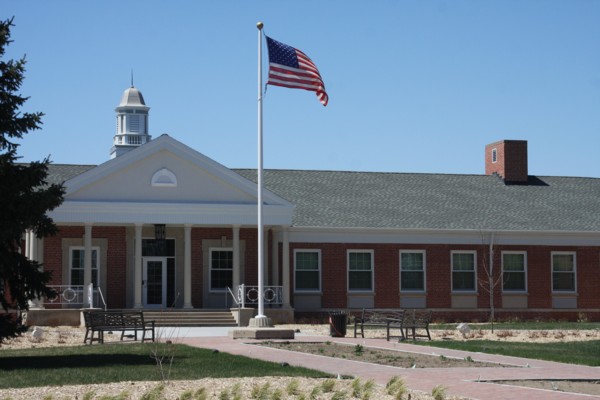
This was the NAD Administration Building. In Naval terms it was referred to as “Mainsides”. It is now part of the Community College.

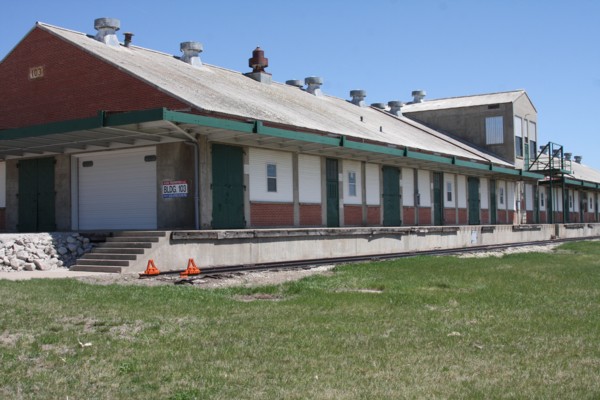
Buildings like this were used for “inert storage” or storage of materials to make the munitions.

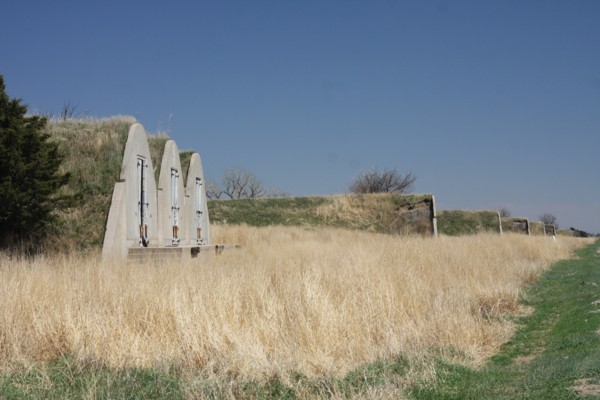
And these are the bunkers where the munitions were stored. They go on for about five or six miles, and I must say they are kind of an eerie sight.



During WWII civilian employees were paid 75 cents an hour and the work week was 60 hours. Weekly pay was slightly less than $45.

More of my photos are here

The most comprehensive information about the NAD is here

The Historical Society has photos from WWII here

Take a tour around the world via your computer by visiting That's My World!

Monday, April 13, 2009

That's My World--Young Cabin


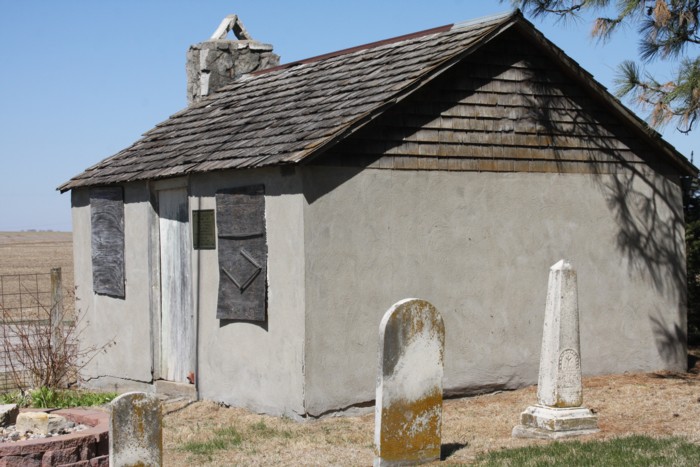
The Young Cabin is at the Young Cemetery and is on the National Register of Historic Places. The cemetery was established in 1855. The cabin was built by the National Youth Administration, a New Deal work project and vocational training program established for the country's young adults. A dwelling originally constructed in 1856 on the William Young family homestead was disassembled in 1941 and its materials, including the hand-hewn logs, were used in the construction of the Young Cemetery Cabin by National Youth Administration workers .

About the National Youth Administration

The huge numbers of unemployed youth of the 1930s underscored several fears adults had for society. Conservatives saw disgruntled young people as a fertile ground for revolutionary politics while liberals mourned the disillusionment and apathy spreading among American youth. Educators feared that without some type of financial aid, colleges would suffer irreversible damage. ER [Eleanor Roosevelt] worried that long-term unemployment and borderline poverty would undermine young Americans' faith in democracy. She told the New York Times that "I live in real terror when I think we may be losing this generation. We have got to bring these young people into the active life of the community and make them feel that they are necessary."
ER, working closely with educators and relief officials, pushed FDR to address this problem. Although at first FDR did not want to develop programs for young people, this lobbying effort changed his mind. In June 1935, he signed an executive order establishing the National Youth Administration (NYA), a New Deal program designed specifically to address the problem of unemployment among Depression-era youth.
The NYA sought to cope with this problem in two ways. First, the administration provided grants to high school and college students in exchange for work. This allowed young people to continue studying while at the same time preventing the pool of unemployed youth from getting any larger. Second, for those young people who were both unemployed and not in school, the NYA aimed to combine economic relief with on-the-job training in federally funded work projects designed to provide youth with marketable skills for the future.


Take a tour around the world via your computer by visiting That's My World!

Monday, April 6, 2009

That's My World!--Filley Stone Barn


Filley’s Stone Barn
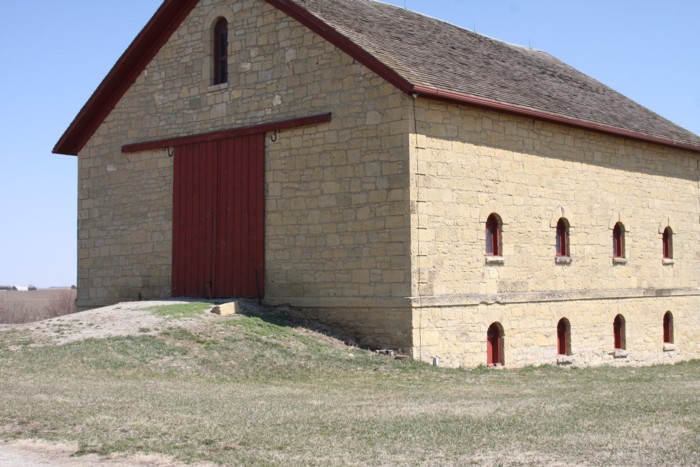
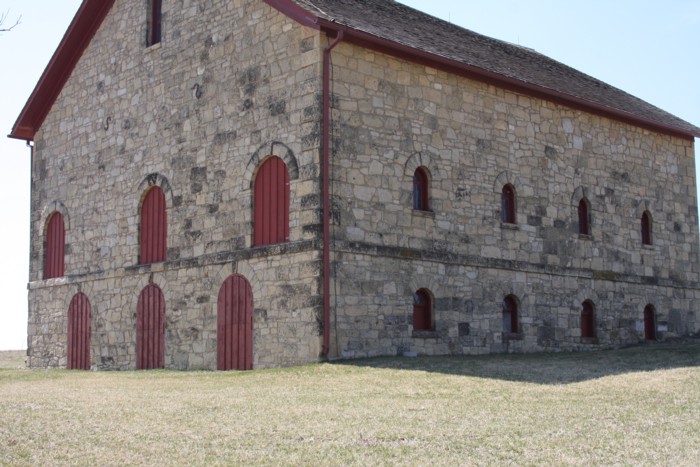
Filley's stone barn -- best known feature of the area -- was built, in part, because of the need for employment during the terrible grasshopper plague and drought that struck in the early 1870s. The project kept many settlers from losing their land. Built into a hillside, the lower level had stalls for 60 animals. The three-inch plank that covered the main floor was caulked with oakum (made from hemp) and covered with melted pitch to be water-tight for 30 additional stalls. The loft held 100 tons of hay. Completed in late November, a stone inscribed "Built By Elijah Filley - AD 1874" was set above the west door, and a grand barn dance was attended by everyone in the community.

The barn, placed on the National Register of Historic Places in 1977, was described as the largest limestone structure presently known, and one of the most magnificent barns in the state. The cost of restoration through grants and by the Gage County Historical Society was many times the original cost of the building. It is now available for numerous activities and hopefully will stand as a land mark for another 100 years or so.


Once in awhile you encounter an informational site and you wonder why you never found it before. Such is the site that the information about Filley’s Stone Barn is quoted from. The site isNebraska…Our Towns. It has, among other things, historical information about six hundred cities and towns in Nebraska.

Boy am I going to bore everyone to tears now! giggle

Take a tour around the world via your computer by visiting That's My World!